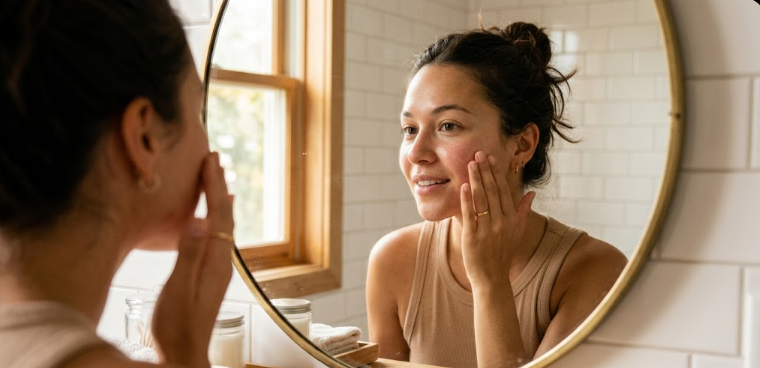
Quick Summary: How to Apply Skin Tint You want to look put together without looking like you tried. Foundation feels […]

Quick Summary: How to Apply Skin Tint
- Start with a dime-sized amount, less than you’d use for foundation
- Moisturize first and wait 60 seconds; sheer formulas cling to dry skin
- Warm the product between your fingertips before touching your face
- Press and pat from center outward; swiping creates streaks
- Build a second layer only on specific spots, never all over
- Set the T-zone only with translucent powder if needed; skip it on dry skin

You want to look put together without looking like you tried. Foundation feels like a commitment. You need the right shade, the right primer, the right tools, and even when you get all of that right, by 2pm it can look like a mask.
Skin tint promises something different. Your skin looks better, not covered. But a lot of people pick one up, apply it the way they’d apply foundation, and end up disappointed. Either it doesn’t seem to do anything, or it looks greasy and strange by noon.
“I was initially confused about the intended use of the product.” — WWD
If you’ve been wondering how to apply skin tint so it actually works, this guide covers it: what the formula is engineered to do, how to prep your skin so it cooperates, and the step-by-step application that produces a genuine no-makeup look. No ten-step process, no jargon.
What Is Skin Tint, and Why It’s Not Just Light Foundation
Skin tint is a sheer, water-based formula designed to diffuse your skin tone rather than cover it. It carries less pigment than foundation and it’s built to blend into skin rather than sit on top of it.
That distinction matters for how to apply skin tint correctly. Foundation creates an even film of coverage across the face. Skin tint evens out the overall appearance of your skin while leaving visible texture, pores, and natural movement. You’ll still see your skin through it. That’s the point.
If you’ve tried applying skin tint and felt like it didn’t do anything, you were likely expecting it to perform like a light foundation. It won’t. It produces a different outcome: skin that looks like it’s having a good day rather than skin with makeup on it.
Coverage works on a spectrum. Skin tint sits at the sheerest end. Tinted moisturizers and BB creams sit above it, and foundations sit above those. Knowing where skin tint lands helps set accurate expectations before you even open the tube.
“Some people may be disappointed by the lack of coverage.” — The Summer Study
That’s not a product failure. It’s a category mismatch. If coverage is the actual goal, skin tint isn’t the right tool, and knowing that before you spend money on it is useful.
What Your Skin Needs Before You Apply Skin Tint
Skin tint is more dependent on what’s underneath it than any other base product. Because the formula is so sheer, it amplifies the condition of your skin rather than covering it. Hydrated, smooth skin produces a seamless result. Dry, unprepared skin shows through as patchiness and uneven texture. Learning how to apply skin tint well starts before you even touch the product.
Start with a clean face. Residual oil, old product, and leftover sunscreen from the previous day all interfere with how the tint sits and how long it lasts.
Apply a lightweight moisturizer suited to your skin type. This is the most important prep step. Skipping it is the most common reason skin tint looks patchy, clings to dry spots, or breaks down before noon. Let the moisturizer absorb for at least 60 seconds before you apply skin tint on top of it. If your skin is still tacky, the formula rides on the surface of the moisturizer instead of adhering to skin, and it will migrate through the day.
If your moisturizer is a thick cream rather than a lightweight gel or lotion, give it a full 2 minutes. Rich moisturizers and sheer water-based skin tint formulas don’t layer cleanly when the moisturizer hasn’t fully absorbed. The tint slips rather than blends.
If you’re using a separate SPF, apply it before the tint and let it dry completely. Chemical sunscreen formulas can interfere with how a sheer skin tint adheres if they’re still wet at application time.
Primer is optional and, for most skin types, unnecessary. It can actually cause sheer formulas to pill on dry skin. If you have oily skin and need extended wear in a hot or humid environment, a light pore-blurring primer on the T-zone only can help. Applying it all over isn’t needed.
Can you apply skin tint without moisturizer? No. Sheer formulas cling to dry patches and produce an uneven finish on bare skin. Moisturized, prepped skin is what the formula is built for. Skip moisturizer and the skin tint will amplify every dry spot and rough patch rather than smooth them.
How to Apply Skin Tint, Step by Step
How to apply skin tint correctly comes down to one principle: less product, better placement. Every step below is built around that.
Step 1: Dispense less than you think you need
The first thing to understand about applying skin tint is that a dime-sized amount covers most faces completely. Skin tint isn’t applied like foundation, and most application failures happen because too much product gets dispensed and blended into something heavier than intended.
Start small. You can build targeted coverage after the first layer. Starting with too much isn’t fixable without removing everything and beginning again.
Step 2: Warm the product between your fingertips
Rub it between your middle and ring fingers for 3 to 4 seconds before touching your face. Finger warmth helps the formula meld with skin rather than dragging across it. Cold product applied directly pulls rather than blends. This one step changes the quality of the finish without adding any time to the routine.
Step 3: Press from the center outward, and don’t swipe
Dot the product at the center of your forehead, both cheeks, your nose, and your chin. Press each dot outward with a patting motion rather than a swiping one. Swiping drags the formula and creates streaks. Pressing pushes it in and produces a diffused finish.
The center of the face carries the most visual weight. Concentrating product there and letting it thin toward the edges is what makes applying skin tint look natural rather than applied.
Step 4: Let the edges disappear
Don’t drag the product to your hairline or jaw. Apply to the central face and let it fade naturally at the perimeter. Visible edges, where the product clearly starts and stops, are what make any base product look applied. Skin tint fades well when you let it. Dragging it toward the hairline creates a line.
Step 5: Build coverage only where it’s needed
If redness beside the nose, discoloration on the cheeks, or other areas still show through after the first layer, add a second application to those spots only. Applying a second full-face layer is what produces the greasy result people complain about. One even layer all over, then a second layer precisely where coverage is needed.
“I still noticed at the end of the day, that some had rubbed off and some of my redness was showing through again as well as some acne scarring.” — Lemon8
Spot concealer works better than additional skin tint for persistent discoloration. Apply it after the tint has settled, not before, and blend the edges so both products sit at the same finish level.
Step 6: Set the T-zone only, if needed
A light dusting of translucent powder over the T-zone controls shine on combination or oily skin without breaking the skin-like finish that makes applying skin tint worthwhile. Setting the full face with powder defeats the formula.
If you have dry skin, skip this step entirely. Powder on top of a sheer formula on dry skin produces a chalky, flat result.
Skin Tint vs Foundation: Which One Is Right for You
Knowing how to apply skin tint matters less if it isn’t the right product for what you’re trying to do. Before you apply skin tint, it’s worth being clear on what outcome you’re actually after.
Skin tint works best when diffusion is the goal. If you want your skin to look more even and healthier without looking like you’re wearing makeup, this formula serves that well. It performs best on balanced skin: normal or mildly oily, well-hydrated, without significant texture or active breakouts.
Foundation works better when coverage is the actual goal. Significant discoloration, active breakouts, or occasions when a more polished look is needed all call for a formula with more pigment and a stronger film. Trying to build skin tint to that level means applying too much product, which produces the heavy result you were trying to avoid.
“I don’t have that heavy, greasy feeling that I sometimes get at the end of the day when wearing a full face of makeup.” — Marie Claire
If you want the coverage control of foundation with the finish of skin tint, spot concealer applied over settled skin tint is the cleaner approach. Apply skin tint first, let it settle for 60 seconds, then apply concealer only where it’s needed and blend the edges.
For days when you want more coverage control but still want a lighter result than traditional foundation, a serum foundation applied with a brush tends to work more precisely than layering skin tint on top of itself. [Internal link → /serum-foundation-application/]
The Best Drugstore Skin Tints for Beginners
Knowing how to apply skin tint correctly gives you more flexibility with which product you choose. But the formula you’re working with determines how much margin for error the application has. These three options cover a practical range of budgets, and each one suits a slightly different skin situation.
If you’re completely new to skin tint and want to spend as little as possible while you figure out whether it works for your routine, the Maybelline Dream Fresh BB Cream is a low-stakes entry point. It delivers slightly more coverage than most true skin tints, which suits anyone who’s nervous about going entirely sheer when applying skin tint for the first time. It’s available at most drugstores and performs reliably on normal and combination skin.
[AAWP block — Maybelline Dream Fresh BB Cream]
The e.l.f. Halo Glow Skin Tint SPF 50 brought a lot of beginners into this category when it launched, and it remains one of the most practical options at any price. At $14 with built-in SPF 50, it functions as both a complexion product and your morning sun protection, cutting a step from your routine rather than adding one.
It performs best on balanced or mildly oily skin. On very dry skin, the formula can look tight or settle into texture unless prep is thorough. The shade range is reliable for fair through medium-deep skin tones. If your skin runs deep or very deep, shade accuracy becomes less consistent and undertone options narrow. That’s worth knowing before ordering online without a swatch.
[AAWP block — e.l.f. Halo Glow Skin Tint SPF 50]
The Charlotte Tilbury Hollywood Flawless Filter is the product the e.l.f. version is most often compared to, and at the aesthetic level the comparison is fair: both deliver a glow-diffusion finish. The formulas are different, though. Charlotte Tilbury’s is heavier, more buildable, and more forgiving on dry skin. If you’ve been applying skin tint with the e.l.f. version and find it too sheer or too tight-feeling by midday, that’s the specific gap this product fills.
[AAWP block — Charlotte Tilbury Hollywood Flawless Filter]
A note on shade selection: skin tint shades run lighter than foundation shades. Go one shade lighter than your foundation match and compare to your neck rather than your face. Because the formula is sheer, a shade that’s slightly lighter blends naturally. A shade that exactly matches your face tends to sit as a visible film instead.
Common Skin Tint Application Mistakes and How to Fix Them
Most skin tint application problems trace back to one of five situations, and most of them are fixable without switching products.
Using too much product is the most common issue. A dime-sized amount is the full application for most faces. More than that produces a greasy, heavy finish that looks nothing like what skin tint is supposed to deliver. If yours consistently looks like too much, reduce the amount before changing anything else about your technique.
Skipping moisturizer is the second most common problem. Sheer formulas amplify what’s underneath them. Dry, unprepared skin shows through skin tint clearly, and no amount of careful blending will compensate for it. Moisturizer isn’t optional prep; it actively changes how the formula sits.
Applying over still-wet moisturizer creates a different issue entirely. If you apply skin tint immediately on top of a thick cream that hasn’t absorbed, the two formulas don’t layer cleanly. The tint slips rather than adheres and separates through the day. The fix is a 2-minute wait, not a product change.
Matching shade to your foundation shade is a mistake specific to applying skin tint for the first time. Skin tint shade ranges run lighter than foundation shade ranges. Going by your foundation match typically lands you one shade too dark, which creates a visible film rather than a diffused wash. Shade down once and match to your neck.
Finally, expecting coverage the formula wasn’t built to deliver leads to over-application every time. “Under my eyes it makes it crease and doesn’t give enough coverage. If I use my concealer it makes it look dry.” — Lemon8. Skin tint isn’t formulated for the under-eye area. A separate concealer applied on top of the settled tint and blended at the edges gets you the coverage you need without disrupting the finish everywhere else.

The Difference Is Usually in the Prep
Most skin tint frustrations come down to one of two things: too much product, or skin that wasn’t ready for it. Neither of those is a reason to write off the category.
If your first attempt looked greasy, you most likely used foundation-sized amounts on a formula that only needs a fraction of that. If it looked patchy or tight, your skin needed more hydration before application. Both are fixable without buying anything new.
Applying skin tint well is genuinely straightforward once you know what the formula is built to do. It doesn’t cover your skin; it works with it. That means the condition of your skin before you apply matters more than the product you choose or the tools you use. Get the prep right, use less than you think you need, and let the edges fade. That’s most of it.
Once it clicks, it tends to replace foundation on the days when you just want to look like yourself. That’s what it’s designed for.
Frequently Asked Questions About Applying Skin Tint
What is the difference between skin tint and foundation? Skin tint is a sheer, diffusing formula that evens out your skin tone while leaving visible natural texture. Foundation is engineered to deliver a defined level of coverage and creates a more opaque film on skin. They produce different outcomes. Skin tint isn’t a lighter version of foundation; it’s a different category with a different job.
Can you wear skin tint without primer? Most people don’t need primer when applying skin tint. Primer adds a layer that can cause sheer formulas to pill, especially on dry skin. The exception is oily skin in humid conditions, where a light pore-blurring primer in the T-zone can extend wear time without affecting the finish.
How do you stop skin tint from looking greasy? Start with a dime-sized amount and don’t apply a second full-face layer. If the formula still reads oily on your skin type, dust translucent powder over the T-zone only after the tint is fully blended. Setting the entire face with powder is too heavy for this formula category.
Is skin tint good for oily skin? It depends on the product. Sheer, water-based formulas work on oily skin when paired with a light mattifying primer in the T-zone and a translucent powder finish. Heavier glow-booster formulas tend to amplify shine on oily skin rather than control it. Reading reviews for your specific formula type matters more than reading reviews for how to apply skin tint in general.
Can you layer skin tint with concealer? Yes. Apply skin tint first, let it settle for 60 seconds, then apply concealer on the spots that need it and blend the edges so both products sit at the same finish level. Applying concealer before skin tint creates pilling; always apply skin tint first.
Poll
Skin tint has basically replaced foundation in my routine.
- Yes, I haven’t touched my foundation in months
- No, I use it on low-effort days but reach for foundation when it counts
- I layer them both and refuse to pick a side
Why did you vote that way? Drop your take below.